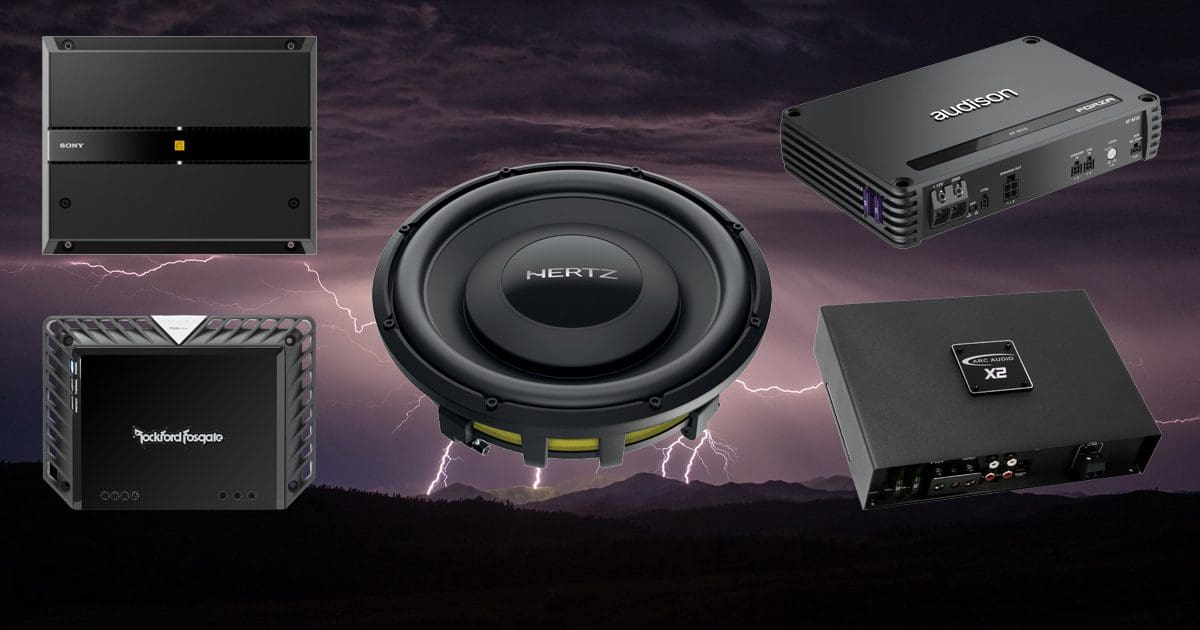
You’d think it’d be easy to choose an amplifier of a specific power rating to work with a 500-watt subwoofer. In reality, we need to consider several factors, particularly performance and reliability. Let’s take a detailed look at the complexity of choosing the perfect amplifier for your car audio subwoofer system.
The Myth and Mystery of Car Audio Amplifier Power Ratings
Let’s start by talking about amplifier power ratings, since this is an area the BestCarAudio.com editorial team is moderately obsessive about. Measuring practical amplifier power production requires rules. The industry standard for power measurement is defined in the ANSI/CTA-2006-D Testing and Measurement Methods for In-Vehicle Audio Amplifiers standard. Without getting too into the details, this standard requires that the audio signal be reproduced with no more than 1% total harmonic distortion and noise into a specified load and that the amp be powered with 14.4 volts. More supply voltage, which usually results in more power being produced, would be cheating. Not specifying THD+N in the rating is also cheating.
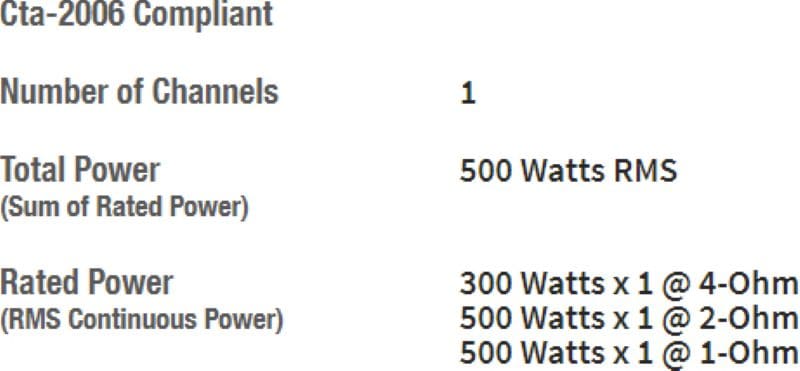
If you’re shopping for an amplifier for your subwoofer, you need to know how much power it will actually produce in your vehicle. You’ll know you’re in good hands if you see the CTA-2006 quoted in the specs. Some companies will specify identical or similar criteria but forego the standard. That’s odd but fine. Further, some companies under-rate their amplifiers’ power production capabilities. While this is often good regarding a value proposition, it might mean you have enough power to damage a subwoofer. Sadly, some companies flat-out lie about how much power their amplifiers can produce, and that’s a problem.
Subwoofer Power-Handling Ratings
If making sense of amplifier power ratings gave you a headache, try dedicating some time to figuring out subwoofer power ratings. The ANSI/CTA 2031 Testing and Measurement Methods for In-Vehicle Loudspeaker Systems and the ANSI CTA-426-B Loudspeaker, Optimum Amplifier Power standards describe a test where a speaker must play a test signal for a minimum of eight hours at a specific average power level without inducing any damage to the driver.
Variability and accuracy in providing real-world specifications are once again an issue. If you look at subwoofers from reputable brands, you’ll see that drivers with standard component features typically have similar power ratings. For example, as you move up through this company’s subwoofer series, their power ratings, which are specified as being CTA-2031-compliant, increase in proportion to voice coil diameter. The chart below gives you an outline of the relationship between voice coil size and power handling.
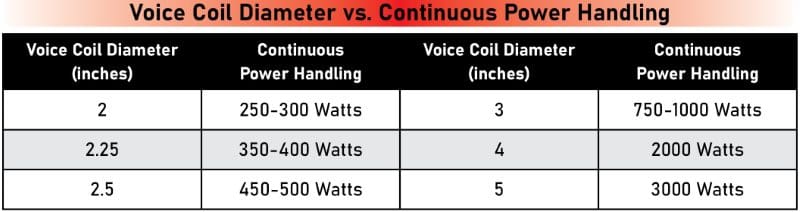
While venting under spider mounting ledges, vented pole pieces and vented formers can help, it’s unlikely you’ll find a subwoofer with a 2-inch diameter voice coil that can handle more than 500 watts of power for eight hours. Nevertheless, many companies make these claims.
So, how do you know what’s reasonable regarding power-handling ratings? The chart above is a good guideline, but some subwoofers might have small-diameter four-layer voice coils or designs with added length that also help dissipate heat. The mobile enhancement retailer you’re working with will have a good idea of how much abuse their subwoofers can take.
What Happens When a Sub Gets Too Much Power?
Because speakers and subwoofers are notoriously inefficient, most of the power sent to them is converted into heat. Usually around 99% is wasted in heating the coil, voice coil former, top plate, T-yoke and magnet. As we explained here, bigger subwoofers with heavier cone assemblies are often less efficient.
No matter what features are included in a subwoofer design, once the voice coil gets too hot, it will melt the varnish or adhesive that holds the assembly to the former. When this happens, the coil usually unravels and physically interferes with the top plate. The coil often rubs for a while rather than failing instantly. Nevertheless, the damage is permanent.

Another consideration in matching an amplifier to a subwoofer is physical power handling. It’s easy for someone unfamiliar with how to model a subwoofer in an enclosure to design a solution with physical power-handling issues. Subwoofers need enclosures to limit cone travel. When an enclosure design is incorrect, a subwoofer might bottom out, and the former will run into the back plate, or the spider might be stressed and damaged where it attaches to the cone.
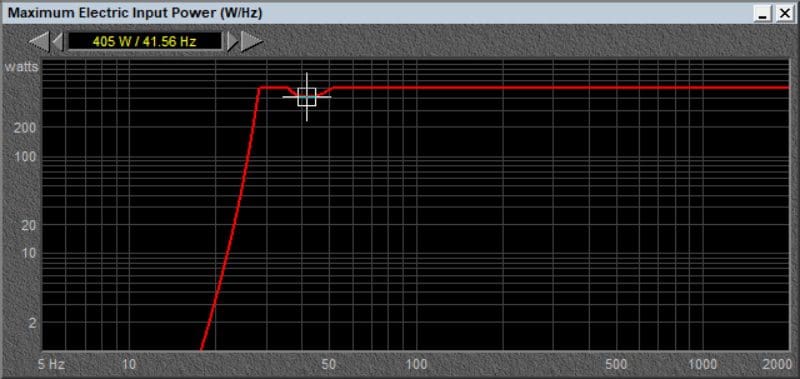
The Power vs. Frequency graph above shows that a subwoofer rated to handle 500 watts of power can only handle just over 400 watts around 42 hertz because of the design of this seemingly simple 1-cubic-foot vented enclosure.
Picking the Right Amplifier for Your Car Audio Subwoofer
This topic is more complicated than it appears on the surface. Let’s simplify things a bit so you can head to your local specialty mobile enhancement retailer with a plan. Don’t skimp on subwoofers if you want your audio system to play at high volume levels. Choose high-quality drivers with real power ratings. Then choose a high-quality amplifier with a similar power rating. So, if you have a 500-watt subwoofer, then an amplifier capable of producing 500 watts into the current load impedance for that driver is a good choice.
What happens if you have less power than the sub can handle? Not much. The sub won’t play as loudly. If you push the amp to clip, that will put more heat into the voice coil, but it won’t make your music any louder. Make sure the shop that installs your amp and subwoofer has the tools and training to set the sensitivity controls on the amplifier properly. What if you have too much power? Well, it’s easy to put too much heat into the sub. If you are listening to music, a 650-watt amp on a 500-watt sub isn’t a recipe for instant disaster. You have to use that extra power for something bad to happen. For example, if you’re playing test tones to measure maximum SPL readings, you might be in trouble.
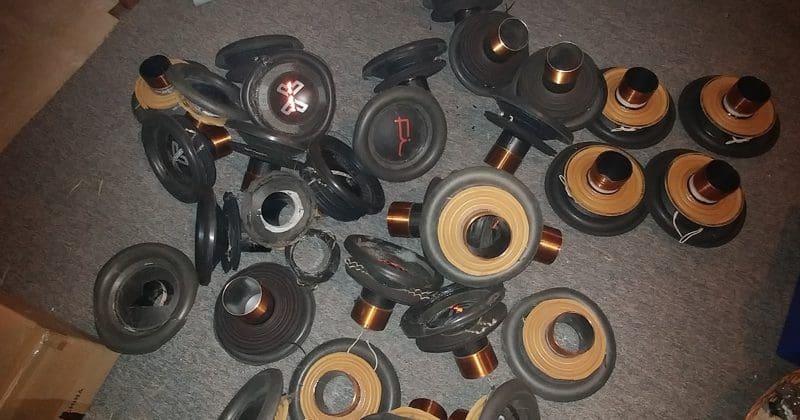
If you want the subwoofer system to sound great and last for decades, use a high-quality subwoofer amp and lots of drivers, then under-power the subs. If you have four 500-watt subs, choose a 1,000- to 1,200-watt amp. This will produce lots of bass but will never push the subwoofers near their limits. This reduced drive level not only allows the subwoofers to last longer, but they will sound better. Of course, don’t compromise on a proper enclosure design only to increase the number of subwoofers in the system.
One last thought: If you want your music to sound the best it can, focus on choosing an amplifier with excellent distortion ratings rather than focusing on power. Power ratings aren’t in any way related to sound quality. Some of the most powerful amps we’ve seen sound terrible. Choosing a high-quality amp that produces 500 watts of power will produce better bass than an inexpensive or poorly designed amp that produces 800 or 1,000 watts.
Your local specialty mobile enhancement retailer should be able to help you choose the correct number of subwoofers to deliver the kind of bass response you want and match them to an amplifier that will sound amazing.
This article is written and produced by the team at www.BestCarAudio.com. Reproduction or use of any kind is prohibited without the express written permission of 1sixty8 media.
